
The Lake Partner Program is a great example of community water monitoring, bringing together volunteers with a shared interest for lake preservation.
FOCA has partnered since 1996 in the Lake Partner Program (LPP). The LPP is a province-wide, volunteer-based, water-quality monitoring program – the largest of its kind in Canada. Each year, hundreds of volunteers collect total water samples and make monthly water clarity observations on their lakes. The samples are analyzed by scientists in the Ontario Ministry of the Environment, Conservation and Parks. The long-term dataset informs scientists, government, and community groups across the province.

June 2025 – Our voices were heard! FOCA has a signed agreement with the Ontario Ministry of the Environment, Conservation and Parks (MECP) that enables us to continue the LPP over the coming five years, with the support of our hundreds of volunteer Lake Stewards throughout the province. Read our media release on this news.
Thank you to the 900+ supporters who wrote the Premier, the Minster of MECP, and their MPPs asking for this outcome.
QUOTABLE: ”I want to thank our longstanding partner FOCA for their excellent delivery of the Lake Partner Program – the largest of its kind in Canada – and the hundreds of dedicated community volunteers taking water samples from their local lakes every summer,” said Todd McCarthy, Minister of the Environment, Conservation and Parks. “By continuing to support this vital program, we are able to monitor water quality and take action when needed to protect the health of lakes and communities across Ontario.” (June 20, 2025)
Lake Stewards: please proceed with your water sampling as usual. The Assistant Lake Stewardship Coordinator is back in action, and your returned samples will be processed at the Ministry lab as usual. We appreciate your patience as we dig out the inbox from the past two and a half months and return to action!
June 2025 – MORE GREAT NEWS TO SHARE! The 2023 and 2024 data has been released by our partners at MECP, and is now available digitally, including new sulphate data from 2017 onward (learn more about sulfite below):

If you need help accessing your data, reach out to lakepartner@foca.on.ca for assistance during business hours.
FOCA members can also ask for a customized Lake Report, if their lake has at least 5 years of sampling data collected!
Thank you everyone for our ongoing support of this important program, and your support of FOCA!
If you are in a position to do so, please consider making a one-time or recurring donation to support FOCA. We work year-round on behalf of waterfront Ontario.


The goal of the Lake Partner Program is to better understand and protect the quality of Ontario’s inland lakes by involving citizens in a volunteer-based water quality monitoring program.
Scientific analysis of the samples is conducted at the Inland Waters Section of the Environmental Monitoring and Reporting Branch of the Ministry of Environment Conservation and Parks (MECP lab).
Samples are tested for total phosphorus, calcium, chloride, sulphate, and water clarity. After careful scientific quality-checking, the dataset is released to the volunteers, the public, researchers and other scientists.
The LPP dataset spans nearly three decades, and can assist in the early detection of changes in the nutrient status and/or the water clarity of the lakes, due to the impacts of shoreline development, climate change and other stresses.
Find out if sampling is happening at YOUR waterbody. If not, we hope you will consider becoming the newest Lake Partner Program volunteer!
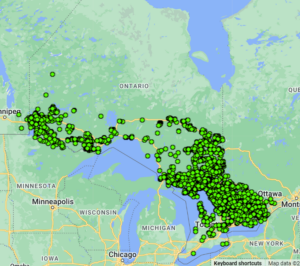
Data collected up to 2022 can be reviewed on the interactive map maintained by MECP by clicking the image at the side, or use links above for access to data up to 2024. We understand from our Ministry partners that an effort is underway to update the map; stay tuned for updates.
No recent results for your inland Ontario lake?
We might need YOU as a volunteer!
Volunteer involvement requires the collection of one water sample for total phosphorus in May for lakes on the Canadian Shield, or one sample each month (May-October) for lakes that are off the shield.
These samples are returned, postage-paid, to the MECP lab for scientific analysis.
In addition, volunteers are asked to make a minimum of 6 monthly water clarity observations using a Secchi disk. (To learn more about the Secchi disk, watch the sampling video below!) These observations are mailed back to the lab at the end of the summer.
Wondering what it’s like to participate in the LPP? Read first-hand accounts from our Lake Stewards who are the volunteer backbone of the LPP, in an article on page 24 of the 2023 Ontario Lake Stewards Magazine (PDF, 32 pages).
Watch our short YouTube videos below, created with our 2024 summer student, Adam T, and our Assistant Lake Stewardship Coordinator, Gavin Vance!
LPP SAMPLERS:
Find out more about the full sampling process of the LPP by watching the video at the side.
Ready to volunteer? Download & return the LPP Volunteer Registration Form! (fillable PDF, 1 page)
Want more information about the LPP? Read onward!
Why Sample?
High levels of phosphorus can lead to algal blooms and in some cases affect the habitat of cold water fish such as lake trout. By sampling the total phosphorus each year it is possible to detect a change in the nutrient status of your lake. It is important to note that several years of data must be collected to observe the normal, between-year-differences before a trend can be identified.
While total phosphorus concentrations are the best way to describe the nutrient status of your lake, regular Secchi depths can also help to identify changes in water clarity that are not linked to nutrient status (zebra mussels, climate change, etc.). Calcium and chloride data have also been analyzed in recent years as part of the LPP data sets.
NEW: About Sulphate Data Released in 2025
Sulphate is widely distributed in the natural environment, occurring in sedimentary rocks (e.g., gypsum) and in the upper aerobic layers of soil where sulphide is converted to sulphate.
The decomposition of plants and animals contributes sulphate to the environment since sulphur is a major plant nutrient and plays an integral role in ecosystems.
Sulphate is present in the atmosphere and is significantly increased by coal combustion, metal smelting activities and other industrial activities. Emissions of sulphur dioxide to the atmosphere are dissolved by precipitation and returned to the earth as dilute acids. This acid precipitation has detrimental effects on vegetation and aquatic life, and corrosive effects on human-made structures.
Since being measured in 2015, analysis has shown that 0.6% (5 of 782 lakes) of lakes have concentrations above British Columbia’s guideline for very soft water lakes of 128 mg/L sulphate. These elevated sulphate levels are primarily found in lakes impacted by historical industrial activities, such as mining and smelting in the Sudbury area, which have led to long-term changes in sulphate concentrations. The concentrations observed are within the expected range for lakes in regions with a history of acid rain and industrial emissions.
Sulphate monitoring in Ontario’s inland lakes helps track trends and inform management decisions related to lake health.
More About the Lake Partner Program:
Download a digital copy of the full Lake Partner Program Report (2020, PDF, 43 pages) including:
- the program history
- citizen science involvement
- data trends
- case studies of how the long-term data is used

Additional Sampling Tools & Related Guides:
- LPP Data Life Cycle (1 page)
- LPP: an overview – slide presentation (23 pages)
- Guide to Interpreting Total Phosphorus and Secchi Data (pdf; 4 pages)
- LPP Secchi summary (2 pages)
- LPP Calcium decline factsheet (2 pages)
- 2015 LPP Report Card (16 pages)
- Blue Green Algae and your drinking water system (6 pages)
- Blue Green Algae (6pages)
- A FOCA Guide to Citizen Science at the Lake (52 pages)
Articles about the LPP in FOCA's Newsletters:
- 2022: Learn more about each of the sampling parameters (phosphorus, calcium, chloride, water clarity) (PDF, 1 page)
- 2021: Tips & Tricks for Samplers! (PDF, 3 pages)
- 2020: Quick Facts about the LPP & a Case Study of Data use (PDF, 2 pages)
- 2018: Citizen Science & the LPP(PDF, 2 pages)
- 2017: About the LPP Lab; Volunteer Q&A; Algae Blooms (4 pages)
- 2016: Overview of a typical year at the LPP (1 page)

Earlier News…
In 2025, FOCA lobbied successfully to save the LPP:
May 5, 2025 – FOCA issued an urgent call-to-action to our members, supporters, and all Ontario lake enthusiasts to write the Province to save the Lake Partner Program (LPP). Our agreement with the Ministry of Environment Conservation and Parks ended on March 31, 2025, and the current year’s sampling season is now at risk. Click to read a copy of our call-to-action notice which includes the letter FOCA has sent to the Province, as well as a template you can use to craft and send your own message of support!
Supporters were encouraged to customize this template letter to craft personal messages to the Province. FOCA also posted the information on Facebook and Instagram, to aid in sharing with others.
Related News Coverage:
May 15, 2025 – play audioclip: Future of volunteer water sampling program in question due to expiration of provincial agreement (FrequencyNews.ca)
May 15, 2025 – Province urged to renew water program (TheHighlander.ca)
May 7, 2025 – A water quality testing program for Ontario’s cottage lakes is in jeopardy (Cottage Life)
Call-to-Action for the LPP from our partners at Swim. Drink. Fish.

We encouraged everyone to customize this template letter (download MS Word document, 1 page) to craft personal messages to the Province, and shared the information on Facebook and Instagram as well.
In 2020, FOCA lobbied successfully to save the LPP:

FOCA’s sincere thanks to all our members & supporters who wrote the province and their MPPs about the importance of the LPP! The MECP decision to continue funding the program through 2019 was aided by the strong community support for this vital long-term monitoring program.
Results of FOCA’s Call-to-Action: After issuing a call in 2018 for our members to write the MECP in support of continuing the ongoing citizen science being done in the LPP (when ongoing funding was under threat; see more, below), FOCA was pleased to receive a letter in December 2019 that included this statement:
“The Lake Partner Program collects important water quality information from hundreds of lakes across the province, raises awareness of environmental stewardship and promotes citizen science. Without the work and support of FOCA, its members and dedicated volunteers, the ministry would not be able to collect the type and breadth of water quality information needed to understand and protect the health of our inland waters. As such, I am pleased to inform you that the ministry intends to continue its collaboration with FOCA and financially supporting this relationship.”
~Assistant Deputy Minister, Ministry of environment, conservation and parks (MECP), December 2019
FOCA called our members to action in November 2018:
“The Province has made stern warnings about their fiscal situation, and—in the Ernst & Young report (Sept. 21, 2018) and elsewhere—have referenced the need to rationalize or modify their approach to Transfer Payments to partners and service delivery agents. While the majority of such funding is tied to health care and education, any wholesale change to third-party funding/program support may affect small-but-important agreements such as the one between FOCA and MECP for the LPP. FOCA recently met with MECP Minister Rod Phillips and his senior staff, to make them aware of the importance of the work we do together. We value the effort our volunteers put into this program, and the science that it produces – science that otherwise would not exist. We encourage you to write your MPP and the Minister to them them how important water quality is to your community, and how the Province can continue to capitalize on this very cost-effective program, by continuing their modest support of the LPP, through FOCA.“

Please note: the following is archival material, and some links to third-party resources may no longer be active.
November 25, 2021: Insights from a quarter-century of science at the cottage (Great Lakes Datastream/Gordon Foundation)
October 2020: As originally communicated by FOCA in June 2020, the LPP was placed on hold in response to the COVID-19 outbreak and physical distancing requirements, so that the ministry could assess the safest way to continue the program while keeping volunteers and ministry staff safe. This assessment has been completed and the Lake Partner Program is being reinstated with temporary modifications for 2020. Click here to read the full letter from MECP regarding the modifications for the completion of the 2020 sampling season.
July 2019: FOCA contributes to citizen science discussions in India:
Members of the Melles lab at Ryerson University held a 2-day workshop conference in Bangalore, India on the topic of citizen science and volunteer water monitoring, as part of an IC-IMPACTS grant (an organization focused on fostering research partnerships between Indian and Canadian researchers).
During the event, we played a video that FOCA recorded specifically for us, which focused on explaining the volunteers tasks, tools, and protocols that the Lake Partner Program (LPP) uses to facilitate volunteer data collection. The video contributed to ongoing discussion about how methods correspond with different volunteer tasks, and was a welcome addition to an event also filled with fascinating presentations from scientists and citizen science practitioners from organizations like the Wildlife Institute of India, ATREE, the Indian Biodiversity Portal, World Resources Institute, and Data Meet, and participants that included ecology students, and representatives from local think tanks and NGOs.
The LPP video helped us demonstrate some of the great citizen science work that is being done in Ontario, and to show how volunteers can be coordinated to collect useful data at large scales, in an environment with so much freshwater to monitor.
View the video: https://youtu.be/NyzKmQ0QfQE
August 2017 – download the article: “Hidden science centre produces RESEARCH that makes a difference,” (PDF, 7 pages) from Unique Muskoka (August 2017 edition, p.25)
Learn more about why citizen science matters, on our webpage: Citizen Science